
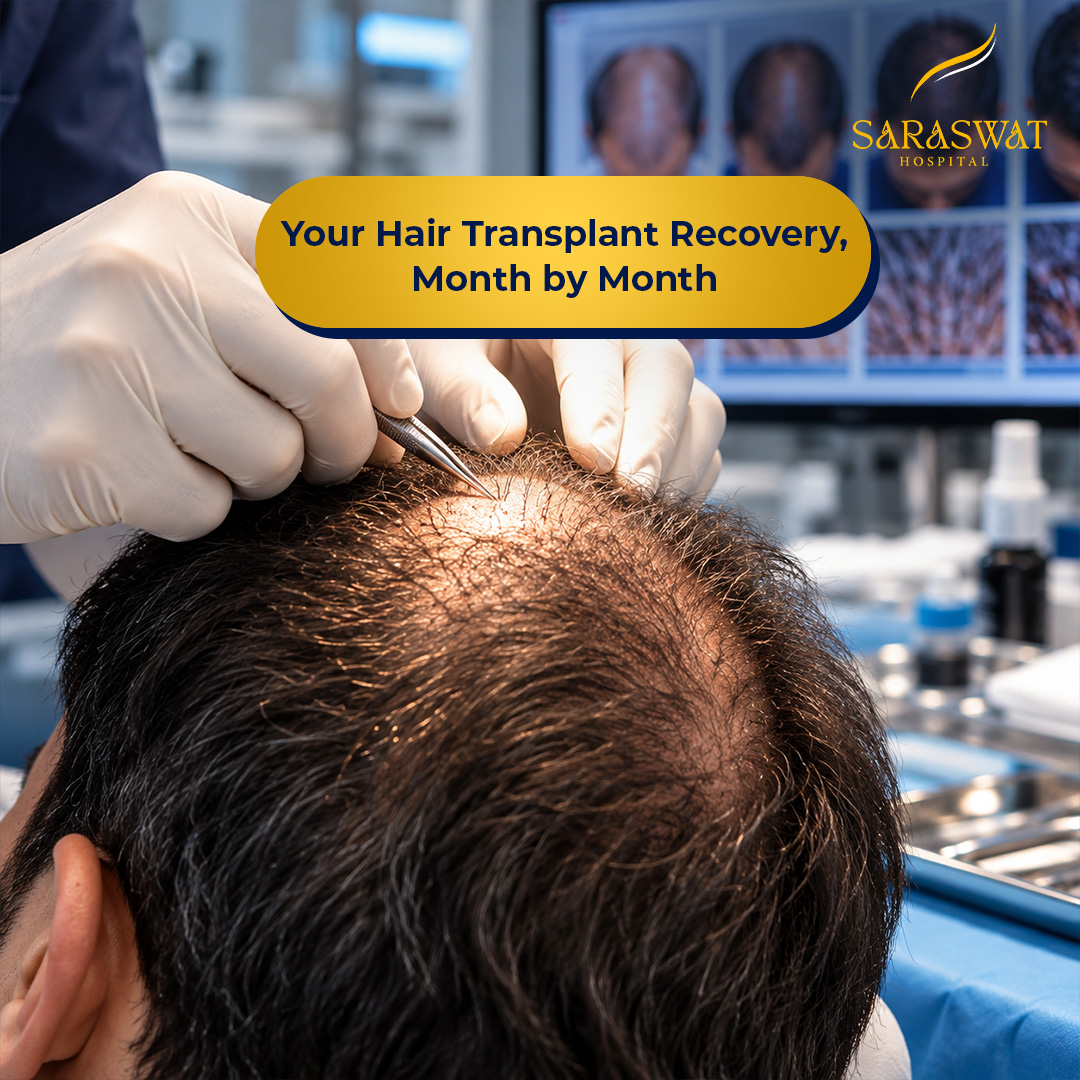
Patients can better expect the initial few days of healing through the entire year of hair growth by being aware of the recovery timeline for hair transplants. Recovery milestones, shedding and shock loss, aftercare, activity limitations, FUE vs. FUT recovery, and when to see a doctor are all covered in this book. It also focuses on how each person’s healing and development can be unique and how following specific medical guidance is important for a safe recovery and outcomes that seem natural.
Hair Transplant Recovery Timeline: What to Expect After 1, 3, 6 & 12 Months
The results of a hair transplant don’t show up right away. It takes time for the transplanted follicles to recover, settle, and begin their normal growth cycle. Patients can better understand what changes to expect in the initial days, weeks, and months following surgery by being aware of the hair transplant recovery time.
Recovery and hair growth vary depending on the patient, the extent of hair loss, the number of grafts transplanted, the technique used, the characteristics of the scalp, and general health, even though many people follow a generally similar pattern. Individualized postoperative care and routine follow-up over the first year are also emphasized as per a recent medical study.
How Long Does Hair Transplant Recovery Take?
While visible hair growth takes several months, the majority of the initial physical recovery happens in the first few weeks. According to Saraswat Hospital, many patients can resume their jobs in a matter of days. Initial healing typically takes two to four weeks, and significant new growth typically starts around three to six months.
The hair transplant recovery and growth journey can be broadly understood as follows:
- Days 1–7: Swelling, redness, mild soreness, itching, and crust formation may occur.
- Weeks 2–4: Crusting reduces, and transplanted hair may shed.
- Around 1 month: The scalp is usually substantially healed, although visible density may be limited.
- Around 3 months: Early new growth may become noticeable.
- Around 6 months: Hair density and coverage generally become more apparent.
- Around 9 months: Continued thickening and maturation may occur.
- Around 12 months: A major portion of the result may be visible, although some patients continue developing beyond this point.
These are general milestones rather than fixed deadlines.
Hair Transplant Recovery: Day 1 to Week 4
The first month is primarily a period of hair transplant healing and graft protection rather than visible cosmetic improvement.
Day 1 to Day 3
The scalp may feel tight, sensitive, or slightly uncomfortable just after surgery. The normal inflammatory reaction following surgery may include redness, swelling, and itching. The recognized postoperative symptoms of hair transplantation include discomfort, oedema, crusting, and temporary inflammation, according to medical reviews. Patients are advised by Saraswat Hospital to safeguard the grafts, initially keep the head elevated, and strictly follow prescribed medication and washing guidelines. The first wash should be done around Day 3, according to its published procedure guidance, though the precise time should be determined by the treating surgeon.
Days 4 to 7
Redness and swelling usually start to go away. Itching may become noticeable, and small crusts may develop around transplanted follicles. Because unnecessary trauma can disrupt recovery, patients should refrain from picking, rubbing, or scratching their scalps. Depending on the treatment and the patient’s occupation, regular office-based tasks can generally be resumed rather quickly. However, unless the treating team gives the go-ahead, intense exercise and activities that cause significant perspiration should be avoided.
Weeks 2 to 4
Crusts gradually separate during this phase, and the scalp keeps healing. Hair transplants usually go through a shedding phase. Shedding of the visible hair shaft does not always indicate the loss of the transplanted follicle, which can be surprising because the scalp may seem less dense than expected. According to Saraswat Hospital, it’s normal for transplanted hair to lose two to three weeks after the procedure. Therefore, gentle cleaning, avoiding unnecessary damage to the scalp, and attending planned follow-ups should be the main focus of your hair transplant aftercare.
Hair Transplant Recovery After 1, 3, 6, 9 & 12 Months
| Time | What You May Expect |
| 1 Month | Healing and possible shedding |
| 3 Months | Early regrowth may begin |
| 6 Months | More visible growth |
| 9 Months | Continued thickening |
| 12 Months | Major portion of results may be visible |
Hair Transplant After 1 Month
Following the process of hair transplant after 1 month, the new hairs tend to fall out, and the hair transplant scalp may have relatively low density. This is a normal process in hair transplant; it is not the final cosmetic result. Although the recipient area is in transition from a wound area to an active stage in the hair follicle growth cycle, the donor area can be a full, fuller, result.
Hair Transplant After 3 Months
Around the stage of hair transplant after 3 months, early regrowth may start to show. At first, new hair may be light, fine, or unevenly distributed. Visible hair growth may start earlier in some follicles than in others. As per Saraswat Hospital’s schedule, noticeable new growth generally starts between three and six months.
Hair Transplant After 6 Months
Since the procedure of hair transplant after 6 months, many patients start to notice more significant changes in density and coverage. Compared to mature hair, freshly emerging hair may still be thinner or have a different texture. Although this is a significant milestone, it is usually too early to declare that the outcome is complete. Over the next few months, we can expect more thickening.
Month 9
Growth usually gets more established in nine months. While texture and blending with neighbouring hair may improve, hair shafts can continue to thicken.
Hair Transplant After 1 Year
A major part of the outcome can be visible following the process of hair transplant after 1 year. As per Saraswat Hospital, the outcome can be seen after around a year; however, individual timeframes may differ. The exact endpoint should be assessed by the treating surgeon rather than relying only on a calendar date because some patients may continue to mature after 12 months.
Hair Transplant Shedding & Shock Loss: Is It Normal?
One well-known aspect of the postoperative process is hair transplant shedding. While the follicles stay in the scalp and eventually resume growing, the transplanted hair shafts may fall out during the first few weeks.
Postoperative effluvium, also known as hair transplant shock loss, is the term used to describe the brief loss of existing or transplanted hairs after surgical trauma. According to a medical review, recipient-site shock loss generally happens two to six weeks following surgery and is usually temporary. But not all cases progress in the same way, and pre-existing miniaturized hair can be more vulnerable.
Also, effluvium at the donor and recipient sites has been identified in a recent study as a potential postoperative consequence. If shedding is accompanied by increasing pain, significant swelling, pus or discharge, fever, spreading redness, continuous bleeding, or other symptoms that look inconsistent with normal healing, patients should get in touch with their doctor. Also, Saraswat Hospital suggests immediate medical assistance in case of fever, foul odour, prolonged pain, swelling, discharge, and extreme redness.
Hair Transplant Aftercare & Returning to Normal Activities
A critical part of protecting the scalp during the healing process is providing effective hair transplant aftercare. The patient’s condition, the procedure, the number of grafts, and the surgeon’s protocol influence the instructions.
Important considerations include:
- Washing: Follow the clinic’s specific washing schedule. Saraswat Hospital advises avoiding scalp washing for the first 48 hours in its published guidance and recommends a gentle first wash thereafter. To learn more, check out our blog: Complete Guide: How Soon Can I Do a Hair Wash After Hair Transplant?
- Touching and scratching: Avoid rubbing, picking, or scratching the transplanted area, particularly during the early healing period.
- Exercise: Avoid strenuous exercise during the early recovery period. Saraswat Hospital’s guidance recommends avoiding heavy exercise for a couple of weeks.
- Swimming: It should be postponed during early healing. Saraswat Hospital advises avoiding swimming for approximately two weeks.
- Sun exposure: Protect the healing scalp from direct sunlight. The hospital advises avoiding direct sun exposure during the first week.
- Smoking and alcohol: Saraswat Hospital advises avoiding smoking and alcohol during the healing period.
- Headwear: Do not wear tight headwear that could disturb the grafts. Ask the surgical team when a particular type of hat or covering can safely be used.
- Sleeping: Keeping the head elevated initially may help reduce swelling.
- Hair styling: Avoid aggressive brushing, chemical treatments, and styling practices that irritate the scalp until your doctor confirms that the scalp has adequately healed.
A consensus of experts from around the world suggests gradually going back to a regular hair care routine and maintaining a strict follow-up in the first year.
What If You Don’t See Hair Growth After 6 Months?
It is not always a sign that the surgery was unsuccessful if the expected density is not seen in six months. Follicles do not all enter the growth phase at the same time, and hair develops according to individual biological cycles.
The timeline may vary depending on multiple factors, including the patient’s hair type, extent of hair loss, surgical technique, graft quality, and personal healing. Current reviews highlight how postoperative outcomes can be affected by both technical and patient-related factors. For more details, read our blog: Timeline for Hair Growth After Hair Transplant?
If there is little to no progressive growth, worsening scalp complaints, severe inflammation, odd scarring, or other unexpected changes, patients should talk to their surgeon about their concerns.
Both FUE and FUT hair transplants are available at Saraswat Hospital. Whereas FUT requires removing a strip of donor scalp, FUE requires extracting individual follicular units. FUT’s wound-healing issues are different from FUE’s since it requires a linear donor incision. Although individual recovery differs, studies comparing postoperative pain have found that FUE has lower early pain levels than FUT.
FAQs About Hair Transplant Recovery
Initial physical healing commonly progresses over the first few weeks. Saraswat Hospital states that full initial healing generally takes about two to four weeks, although individual recovery can vary.
Washing should follow the specific instructions provided by your surgeon. Saraswat Hospital’s published guidance commonly places the first gentle wash around 48 hours to Day 3 after surgery. You can also check out our blog: Hair Wash After Hair Transplant: Essential Tips for more information.
Early new growth commonly becomes noticeable around three to six months, although some patients may see changes earlier or later. For additional details, visit our blog: 7 Tips to Keep Your Hair Healthy After a Hair Transplant
Yes. Shedding of transplanted hairs during the first few weeks can be part of the expected growth cycle. However, unusual or persistent symptoms should be assessed by your doctor
Light activity can often be resumed earlier than strenuous exercise. Saraswat Hospital recommends avoiding heavy exercise for approximately two weeks, but your surgeon’s individualized advice should take priority. To know more, look at our blog: Can You Exercise After A Hair Transplant?
Visible growth may begin around three to six months, with substantial maturation occurring over the following months. A major portion of the outcome may be visible around 12 months.
Hair transplantation can have complications, and outcomes can vary. Medical literature identifies potential issues including infection, inflammation, scarring, effluvium, and other complications. Appropriate patient selection, surgical technique, and postoperative care are important for reducing risks.
Your Hair Transplant Recovery Plan
Early wound healing, brief shedding, and then slow new growth and development are the stages of a realistic hair transplant recovery timeline. The first few weeks are devoted to healing the scalp and protecting the grafts. Early development may start to show up around three to six months, and texture and density can continue to improve nine to twelve months, and in some cases occasionally longer.
The most important step is to strictly follow your surgeon’s specific instructions rather than making excessive comparisons between your development and someone else’s photographs or timeline. A professional assessment can assist in determining whether your progress is within the expected range if you are worried about healing, shedding, or growth. To learn more about hair transplant recovery, read our blog: Heal Faster: 5 Helpful Tips for Quick Hair Transplant Recovery
Patients at Saraswat Hospital receive personalized advice about the procedure, recovery, and postoperative care. Discuss your scalp condition, treatment options, and a personalized aftercare plan with the experienced hair restoration specialists if you’re considering getting a hair transplant or have concerns about your recovery.
Follow us on:- Facebook, Instagram, Pinterest, YouTube
This article is for informational purposes only and does not constitute medical advice. Plastic, cosmetic, and laser treatments — including AI-assisted previews such as those generated by the Peek AI™ app — carry risks and results vary by individual. Always consult a licensed medical professional before undergoing any procedure.