
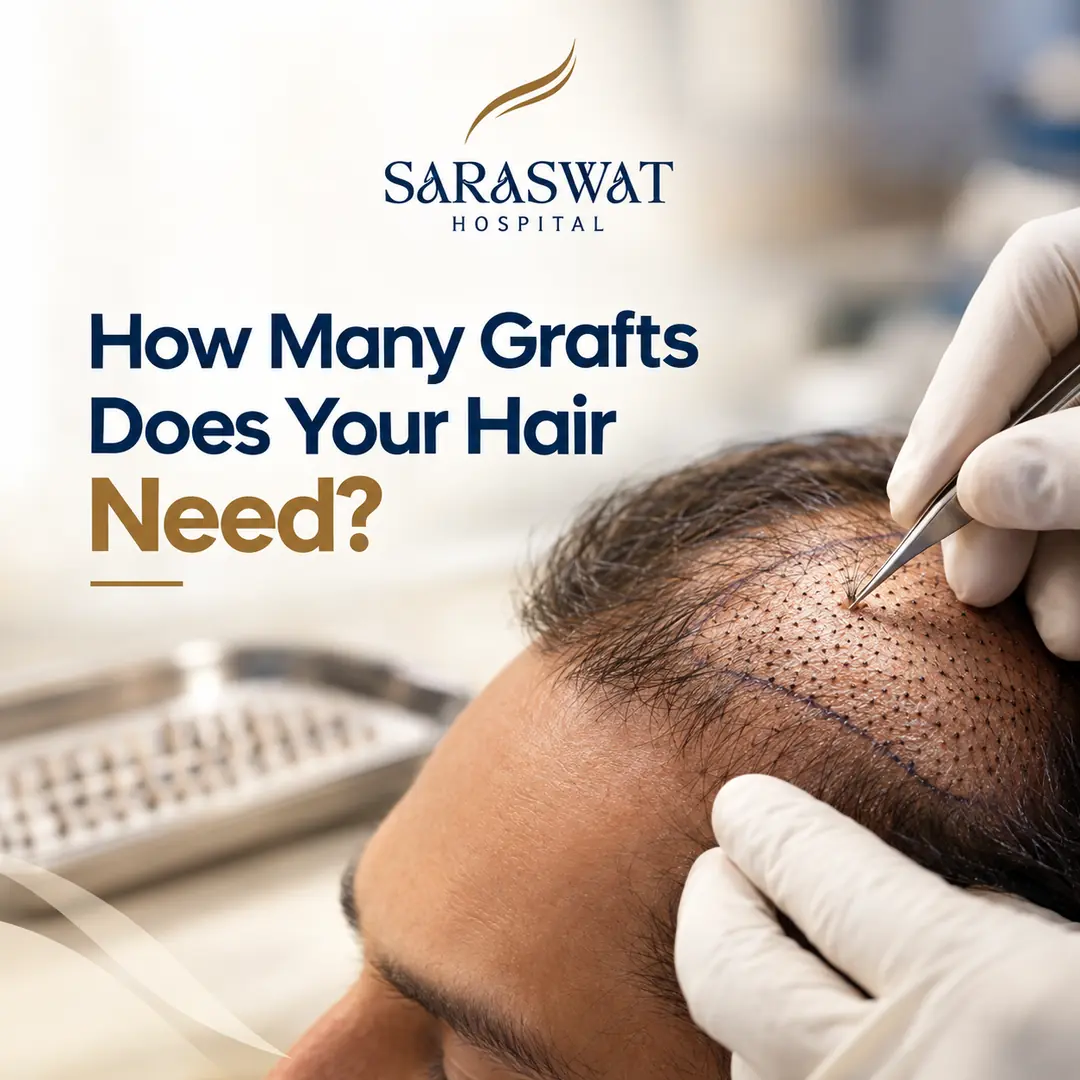
Your choice of hair transplant is not going to be a cookie-cutter approach, but instead will vary based on the pattern, severity, and area of your hair loss and the donor site. A patient with only slight temple hair loss may require far fewer grafts than a patient with a broad frontal, mid-scalp, and crown area of hair loss. How many grafts for hair transplant is just the starting point, as this must be confirmed with a clinical assessment of the patient.
A graft is a naturally occurring grouping of a few hairs that are delicately extracted from a donor area and transplanted into the recipient area. Because of the differences in the number of hairs that can be present in each graft, a patient receiving 3,000 grafts of hair may not result in the same hair coverage or density as someone receiving the same 3,000 grafts. As per medical literature, each follicular unit usually has between one and four terminal hairs.
What Is a Hair Transplant Graft?
Another way to describe a hair transplant graft: It is not a single hair, but a tiny unit of tissue consisting of one or more hair follicles arranged in a normal pattern, thus referring to a follicular Unit. The goal of current hair transplant procedures is to preserve this grouping of hair follicles so that transplanted hair results in a more natural distribution of hair.
Saraswat Hospital explains that one follicular unit generally is 1-4 hair follicles, so you’re not getting 2,000 hairs for 2,000. Your actual number of hairs will be significantly more if your ratio of hairs per graft is high.
This will become evident when you compare the results of two patients with the same hair transplant grafts. For example, the second patient may have received the same number of grafts, but with a greater number of hairs per graft, a smaller donor site, or better hair shaft thickness.
Graft count is important because it informs the surgeon how many grafts need to be taken from the donor area, and how much donor hair supply is available for distribution across the recipient area. While this is definitely a consideration, the critical consideration is how to best use the donor’s supply. Donor hair supply can be quickly depleted if not carefully managed.
How Many Grafts Do You Need for Different Levels of Hair Loss?
The answer to the question “how many grafts do I need?” mainly depends on the areas you wish to restore and the degree of hair loss. A smaller procedure may involve solely restoring the frontal hairline, while more advanced hair loss involves planning the restoration of the frontal scalp, mid-scalp, and crown areas.
Saraswat Hospital has listed the approximate graft ranges according to Norwood-Hamilton grades, which make for a very handy, easy reference to get an idea of how much increase in graft requirement is observed as the Norwood-Hamilton grade increases and our hair loss advances.
| Estimated Graft Range | Typical Hair Loss / Restoration Need |
| 1,000–1,200 grafts | Early recession or limited restoration |
| 1,400–1,800 grafts | Moderate frontal hair loss |
| 1,800–2,500 grafts | More extensive frontal or frontal-mid-scalp loss |
| 3,000–4,000 grafts | Advanced loss involving larger recipient areas |
| 4,000+ grafts | Extensive or advanced hair loss requiring careful donor planning |
Early Hairline or Temple Recession
If hair loss is only in the temples or around the hairline, fewer grafts may be needed. The surgeon typically hopes to create a natural-looking and balanced hairline while still saving donor hair for a potential second procedure.
Moderate Frontal Loss
In more advanced cases of recession that affect a wider area of the frontal scalp, more grafts are required for hair transplant to achieve both continuity and a better illusion of density. Designing the hairline is essential, given the high visibility of the frontal area.
Frontal and Mid-Scalp Loss
When the entire top of the head or just the hairline and mid-scalp are severely thinned, the grafts you have available must be carefully spread out rather than congested. The goal is typically to keep in decent cosmetic coverage whilst preserving donor resources.
Crown Involvement
A crown restoration can need more grafts because of the whorl or round shape of the crown, which makes direction and placement critical. The surgeon also needs to decide whether the crown will still thin before devoting a high percentage of the donor supply to it.
Advanced Hair Loss
With advanced hair loss, the frontal scalp, mid-scalp, and crown can all be bald. This situation severely limits the donor’s supply, and you cannot duplicate a truly full scalp. The aim of a hair transplant becomes spreading out a limited donor supply to give the maximum necessary coverage for a natural result. Medical papers have stressed the limited availability of donor hair, and the impossibility of covering very bald areas with unlimited grafts.
What Factors Determines the Number of Grafts You Need?
Various clinical factors affect the number of grafts needed for the hair transplant, and therefore you should never consider the number you get from our online calculator as a definite surgical recommendation.
- Norwood stage and the area affected: More hair loss usually indicates a bigger recipient area and maybe more grafts needed.
- Donor hair quality: The quantity and caliber of extractable follicular units in the donor area are what make extraction safe.
- Hair thickness and hair-to-graft ratio: Thicker hairs and more hairs per follicular unit will offer a much higher visual cover for the same number of grafts.
- Current native hair: It is also important to consider your native hair to leave in on the areas to be transplanted, as this also adds to the overall density of the transplant.
- Preferred density and hairline shape: A conservative hairline and overall spray density can give a natural look while not overly depleting your donor supply.
- Anticipated hair-loss progression: Some of your existing hair that is not transplanted can still become thinner.
The technique used for hair transplantation can also influence the treatment plan, recovery, and overall cost. To understand the differences between the two commonly used techniques, read our guide on FUE vs FUT hair transplant surgery.
Research and clinical advice have continually stressed the importance of donor-area preservation due to the limited permanent donor supply at hand. A procedure that uses excessive grafts may not leave sufficient reserves for future needs.
How Do Doctors Calculate Your Required Grafts?
Determining the appropriate number involves much more than estimating the size of a bald patch. A proper assessment generally follows a sequence such as:
Donor-area assessment → recipient-area assessment → hair-loss pattern → density planning → donor capacity → personalized treatment plan
The donor area is checked for follicular-unit density, hair condition, miniaturization, and the overall hair that can be removed without resulting in a depleted look. At Saraswat Hospital, trichoscopy is one of the elements of your pre-operative assessment. It helps us to assess the donor density, the miniaturization pattern, and the extent of the treatable area.
Next, the recipient area is examined to evaluate what parts require coverage and where the grafts should be placed. Face shape, facial dimensions, native hair, hair caliber, plus the direction and angle of hair growth are all factors in planning the design.
Online calculators can only give approximate figures due to their inability to evaluate such factors as donor density, individual follicular-unit makeup, miniaturization, hair caliber, and the donor site’s stability over the long term. It is thus necessary to conduct a clinical examination before the actual number of grafts can be determined.
Are More Grafts Always Better?
Number of Grafts – Not All Grafts Are Equal. More grafts will not necessarily improve your hair transplant. It’s more about the strategic use of your existing donor hair and placement of grafts that work with the hair you already have.
Important considerations include:
- Design of Hairline: The hairline should look natural or appropriate, not just set the maximum number of grafts on the front.
- Correct positioning of grafts: Direction, angle, spacing, and distribution are important for the natural look of transplanted hair.
- Donor-area preservation: Overharvesting lowers donor densities and limits future options.
- Tissue viability: why over-clarification may damage tissues.
- Appropriate density: no need or reason to go to an ever-increasing density.
- Greater longevity planning: the plan should cater for possible future progression of hair loss.
The number alone cannot be the definitive answer as to whether 4,000-5,000 grafts in one session are acceptable. Saraswat Hospital lists higher graft ranges for higher-end Norwood grades, but clinical practice guidelines state donor harvesting should be restricted to individual donor parameters; one published guideline defines about 2,500-3,000 grafts per session as an optimal upper limit of average donor harvesting without overt depletion in a single session, but individual surgical plans can vary.
Therefore, the 4,000- or 5,000-graft plan should only be adopted when there is a desire to do so, and the donor situation, the recipient needs, the surgical plan, and other clinical parameters are all in favor of doing it.
Does Graft Count Affect Hair Transplant Cost?
Yes, it can affect cost, as most pricing structures are based on the number of grafts used (although technique, clinic, surgeon, complexity, etc. will all have an effect).
According to Saraswat Hospital, factors that influence hair transplant costs are the number of grafts, type of technique, the clinic, the experience and skills of the surgeon, and the extent of hair loss. If you are researching hair transplant cost in India, these factors can significantly influence the overall treatment cost. Saraswat Hospital has published cost details for FUE and FUT techniques, and you can also learn more about hair transplant cost per graft in India to understand how graft count can affect the overall price.
Frequently Asked Questions
Approximately 1,000 grafts hair transplant may be sufficient for limited hairline or temple restoration in some patients, but it may not provide adequate coverage for larger areas of hair loss. Saraswat Hospital lists approximately 1,000–1,200 grafts for some Grade 2 cases.
There is no universal number for a full hairline because the requirement depends on the width of the hairline, degree of recession, desired density, hair characteristics, and available donor supply. A clinical assessment is necessary to establish an appropriate number.
A 2,000 grafts hair transplant procedure can be appropriate for certain moderate cases, particularly when the primary treatment area is the frontal scalp. Saraswat Hospital’s published ranges include approximately 1,500–2,000 grafts for some Grade 3V cases and 1,800–2,200 for Grade 3A cases.
Coverage depends on the density selected, hair-to-graft ratio, hair thickness, and recipient-area characteristics. Saraswat Hospital notes that a 3,000 grafts hair transplant procedure may be used for Norwood Grades 3–4 and estimates coverage of approximately 60–75 square centimetres in a particular context, but individual coverage can vary.
Not necessarily, but 4,000 grafts hair transplant should not be considered appropriate simply because extensive hair loss is present. Donor capacity, recipient-area size, hair characteristics, and future hair-loss planning must all be considered before undertaking a large session.
A graft can contain approximately 1–4 hairs. Therefore, graft count and individual hair count are different measurements.
There is no single safe number that applies to every patient. Donor density, donor-zone dimensions, hair characteristics, age, future hair-loss risk, harvesting method, and previous procedures all influence safe harvesting limits. Published clinical guidance specifically stresses preserving the donor area and avoiding visible depletion.
Find Out How Many Grafts You Actually Need
How many grafts you need is a very personal thing, not a set number for all. An individual with a minimal receding hairline may feel 1,000 – 1200 grafts would give you a good result. An individual with significant loss at the front, mid-scalp, and crown area might need several thousand grafts or a staged procedure.
Some of the most important factors are the level of donor density, hair-loss pattern, hair-to-graft ratio, extent of native hair, target density, hairline design, and your long-term treatment expectations. Your procedure must be designed with the goal of using the donor resource as efficiently as possible without sacrificing aesthetics or affordability.
How many grafts for hair transplant treatment are best for my hair loss pattern? The safest way to get an individualized answer to this question is to see the individual for evaluation. Saraswat Hospital believes in judging the potential of donor and recipient beds (coming for planning hair restoration procedure).
Book a Hair Transplant Consultation with Saraswat Hospital
Consult with an experienced hair-restoration team to discuss your pattern of hair loss, donor availability, hair restoration objectives, and treatments to determine the appropriate number of grafts.
Follow us on:- Facebook, Instagram, Pinterest, YouTube
This article is for informational purposes only and does not constitute medical advice. Plastic, cosmetic, and laser treatments — including AI-assisted previews such as those generated by the Peek AI™ app — carry risks and results vary by individual. Always consult a licensed medical professional before undergoing any procedure.