
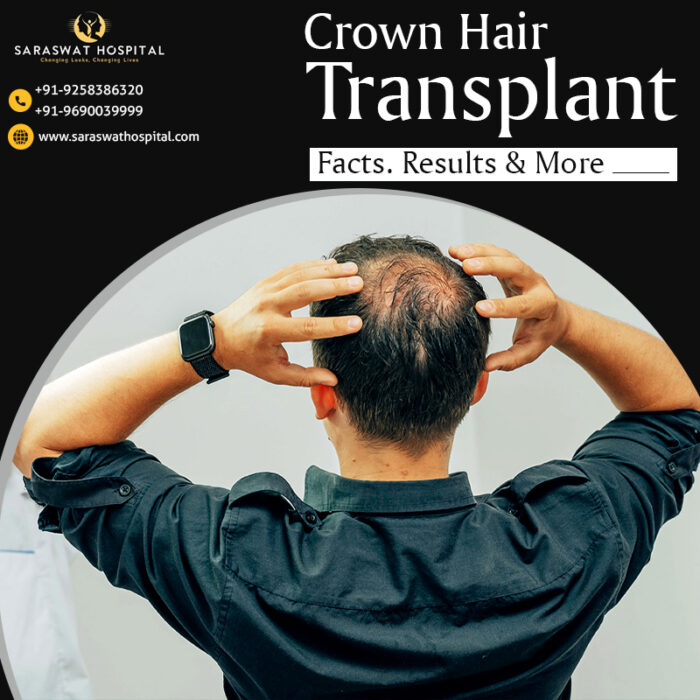
Sometimes referred to as the “bald spot” in the back of the scalp, the crown is one of the most commonly affected areas during Androgenetic Alopecia. Most people, thus, want to treat this zone through a hair loss treatment in Agra. But, there are several things that one has to go through to understand why crown hair loss is important, and if at all they would have to do such surgeries or not. This blog would entail all there is to know about crown hair loss treatment and the probable results of it.
What is a Crown Hair Transplant?
The area that goes beyond the point of transition, after the frontal hairline and the mid-scalp, is known as the crown. This type of transplant is typically undergone by patients who want to correct their balding problems when the scalp starts to slope downwards. Ideally performed with the help of the Linear Excision Method (FUT) or a combination of both FUT and FUE (Follicular Unit Excision), the crown hair transplant results depend a lot on the expertise of the professional performing the same.
Hair Loss in the Crown – Eligibility and Important Facts to Consider
The hair growth from the center of the crown happens in an outward direction when compared to that in other parts of the scalp. When a patient is in stages five and above of the Norwood-Hamilton hair loss stage, he or she suffers from crown hair loss. Some patients also suffer from hair loss in the crown area and not in the frontal region at all. Now, through the crown hair transplant, typically, you will be able to achieve the best results in one sitting. But, before all of that, you need to see if you are eligible for the same or not.
If you are someone below the age of thirty (preferably), the doctors might want to wait for some time before going ahead with the treatment because by then the hair thinning would stabilize. The crown hair transplant procedure should only be attempted when the hair loss is stable and isn’t an ongoing process, or else it would end up looking awkward.
The Trichoscopy analysis of the patient would show if he or she has enough donor hair for the crown transplant or not. Since one has to go through several grafts to achieve a fuller crown transplant, it takes a lot of donor follicles. If the person has an isolated crown, along with enough donor hair, he or she can undergo the process earlier than usual. The apparent density of the crown is always less than what is there in the front region because there is a high degree of separation when the hair growth starts.
A professional would always give a manual of instructions to follow rigorously throughout the time for those suffering from crown hair thinning to delay the progress, following which insulin therapy, micro-needling, or low laser therapy can also be considered for effective results.
Why choose ABHRS-certified doctors?
Saraswat Hospital is one of the most well-known clinics in Agra that offers various types of hair loss treatment in Agra. At the helm of the hospital are Medical Director and Chief Consultant, Dr Satya Saraswat, and the Chief Clinical Cosmetologist, Dr Preeti Saraswat, who has trained a special team to assist them throughout all the aesthetic and cosmetic procedures performed at the clinic. With seventeen years of experience and the use of modern equipment, the clinic is known to provide excellent results.
Conclusion
The decision to undergo a crown hair transplant is important and should only be taken when you are under the consultation of experts. Both the doctors at Saraswat Hospital are certified by the American Board of Hair Restoration Surgery (ABHRS), making sure that they are updated about the various upgrades in the field. Should you want to know more about the same, book a consultation with the experts at Saraswat Hospital today.
Follow us on:- Facebook, Instagram, Pinterest, Youtube