

Hair fall is extremely depressing, with self-esteem and blows to confidence being attached to it. However, again on a positive note, hair transplant methodologies provide very viable solutions for victims of baldness and thinning of hair. Yet again, the availability of different kinds of transplant methodologies has made the best choice in India. In the current times, it has become very tough to select the best hair transplant technique. This guide will help you gain a very deep understanding of the several techniques of hair transplantation surgery.
What Defines a Modern Hair Transplant?
A hair transplant is a popular procedure in which surgeons take hair follicles from the donor area (such as the back or side of the scalp) and transplant the follicles to the recipient area. People who are suffering from Hair Loss, baldness, or thinning hair for various reasons can aim to restore their natural hair via hair transplantation.
Surgeons prioritize graft survivability by maintaining follicles in specialized storage solutions to prevent desiccation during the “out-of-body” phase. Effective results rely on the strategic placement of these grafts to mimic the natural exit angle of native hair. This mechanical foundation leads directly into the specific harvesting methods used to acquire these follicles.
What are the Primary Graft Harvesting Techniques?
Clinicians currently utilize two primary surgical methods for harvesting donor hair: Follicular Unit Transplantation (FUT) and Follicular Unit Excision (FUE). In 2024, approximately 76.8% of global procedures were performed using FUE, reflecting a clear patient preference for minimally invasive options. While both methods move the same biological units, the extraction technique significantly impacts the donor area’s appearance and the patient’s recovery timeline. Each method offers distinct advantages based on the patient’s degree of baldness and scalp laxity. Understanding the mechanics of FUT is the first step in determining suitability for high-graft-count cases.
Is FUT Still the Gold Standard?
Follicular Unit Transplantation (FUT) remains a respected clinical choice for patients requiring high graft volumes because it allows for the harvest of a large number of follicles in a single session. This “strip method” yields a transection rate as low as 1% to 2% when performed under high-powered microscopic dissection. While it leaves a fine linear scar, the technique is often preferred by female patients or men who keep their hair at a longer length to conceal the donor site. It provides an efficient way to address advanced Norwood Grade 5 or 6 hair loss. This high-yield efficiency contrasts with the localized, individual approach found in FUE.

How Does FUE Achieve Scarless Results?
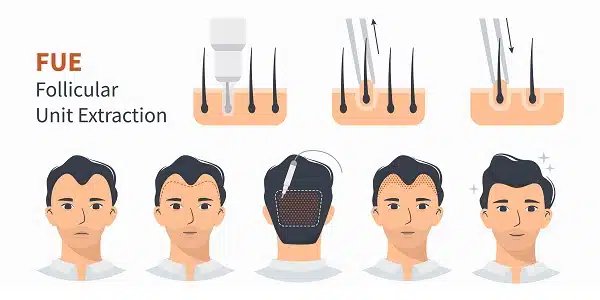
Follicular Unit Excision (FUE) achieves a “scarless” appearance by using micro-punches (typically 0.7mm to 1.0mm) to extract individual follicles directly from the scalp. These tiny extraction sites heal as nearly invisible white dots, allowing patients to wear very short hairstyles without visible evidence of surgery. The procedure is less invasive than FUT, resulting in a faster return to strenuous activity within 3 to 7 days. Because there are no sutures, the post-operative discomfort is significantly reduced. These benefits directly influence how a patient evaluates the overall survival of their transplanted hair.
Which Technique Yields Better Graft Survival?
Graft survival rates are largely comparable between FUT and FUE when performed by experienced surgeons, with modern techniques reaching 90% to 95% success. However, a 2024 study showed that the addition of Platelet-Rich Plasma (PRP) can further boost high-density survival in FUE patients, compared to FUE alone (1). FUT historically maintains a slight edge in hair yield because the follicles are protected by more surrounding tissue during the dissection phase. Choosing between these survival rates requires a precise clinical evaluation of the patient’s current hair density.
Comparing Hair Transplant Methods: FUT vs FUE
It is time to compare these two famous techniques to understand which is the best method for you:
| Feature | FUT | FUE |
| Technique | Strip harvesting | Individual follicle extraction |
| Scarring | Linear scar at the donor site | Tiny, dot-like scars |
| Recovery Time | Longer | Quicker |
| Pain Level | Moderate to high | Low |
| Cost | Lower | Higher |
| Graft Yield | Moderate When FUT and FUR are combined, the graft yield becomes the maximum | Moderate to high |
| Transection | 1% – 2% (Very Low) | 5% – 10% (Moderate) |
How is Patient Donor Density Assessed?
Surgical planning begins with a Trichoscopy report to measure follicular unit density and hair shaft diameter in the permanent donor zone. At Saraswat Hospital, clinicians use tools like the Peek AI™ app to simulate results and calculate the exact number of grafts needed based on donor availability. Surgeons may advise patients with low donor density to combine FUE with body hair transplantation (BHT) to achieve full coverage. This diagnostic phase ensures that clinicians tailor the surgical plan to the patient’s biological capacity. This clinical accuracy is only as reliable as the surgeon’s specialized certifications.
What Credentials Ensure Surgical Success Rates?
Successful hair restoration is dependent on the surgeon’s board certification and specific experience in hair-related microsurgery. Dr. Satya Saraswat holds a Fellowship with the International Society of Hair Restoration Surgery (FISHRS) and a Diplomate status with the ABHRS, credentials that establish globally recognized benchmarks for surgical excellence. These qualifications minimize the risk of “moth-eaten” donor areas or poor graft growth.
How to Choose the Best Hair Transplant Method?
The best method for hair transplantation is selected based on several factors. Some of the key considerations for decision-making are given as follows:
- Degree of Hair Loss: Determine the degree of your hair loss. Surgeons typically combine FUT and FUE for patients with advanced hair loss, while they utilize standalone FUE for those with mild to moderate thinning.
- Cost: Both methods deliver effective results, but FUT costs less than other techniques since it doesn’t involve using an FUE machine.
Growing Popularity of Hair Transplant Procedure in India
With advancements in technology, skilled surgeons, and competitive pricing, India is fast emerging as one of the leading destinations for a hair transplant. Most of the patients throughout the world prefer a hair transplant in India due to the availability of world-class services at competitively reasonable rates. There are several well-known clinics, such as Saraswat Hospital, Agra, India, that will help one get natural-looking results with the least downtime.
Factors Contributing to a Successful Hair Transplant
The right choice of the clinic and surgeon is of paramount importance if it is to yield the best result. Here are a few tips that may ensure a hair transplant goes successfully:
- Research on the Clinic: Mingle with those clinics known to perform successful hair transplant surgeries. Reviews and testimonials from patients who have undergone such surgery will be very important in providing insights.
- Verify the Surgeon’s Qualifications: The surgeon should be certified and must have performed a sizable number of hair transplants.
- Prepare for the Recovery: Follow all types of post-operative care instructions as prescribed by your surgeon with great detail to enhance recovery for good results.
Conclusion
FUT and FUE are both extremely effective methods. The best hair transplant method depends on hair loss severity, budget, preference, and the surgeon’s advice in India. These consultations are important to get to the right decision that suits your needs.
Understanding the difference between FUT and FUE, along with assessing your specific situation, allows you to confidently choose the right hair transplant method and restore your hair effectively.
Sources
(1) Journal of Medicine in Scientific Research, Volume 7 (2), Article 6
FAQs
1. What is the best hair transplant method for a natural look?
The best hair transplant method includes FUT and FUE. Both have the capability of producing natural-appearing results; the degree to which transplanted hair will appear natural upon a person’s head is, for the most part, left up to the skill of the operating surgeon.
2. Are there any big differences in the cost of FUE vs FUT?
Yes, generally, FUE is more expensive than FUT because the FUE machine and punches cost more.
3. Can I have hair restoration surgery if I have a medical condition?
It all depends on the medical condition. You have to consult a hair transplant surgeon to discuss possible health issues and determine if you are a suitable candidate for the surgery.
4. How long after a hair transplant can you expect to see results?
Hair growth will begin three months after the surgery, although the results may take 6 to 12 months to be visible. Complete results may take as long as 15 months.
5. Does a hair transplant hurt?
Surgeons perform both FUT and FUE using local anesthesia, ensuring patients experience minimal pain during the procedure. Patients manage any post-operative discomfort effectively with medication.
Follow us on:- Facebook, Instagram, Pinterest, Youtube
Read More:- Understanding Hair Transplant Cost Per Graft in India, Can a Hair Transplant Fail?